Launch offer — valid today only

📄 Digital book in PDF · read it on your phone or print it

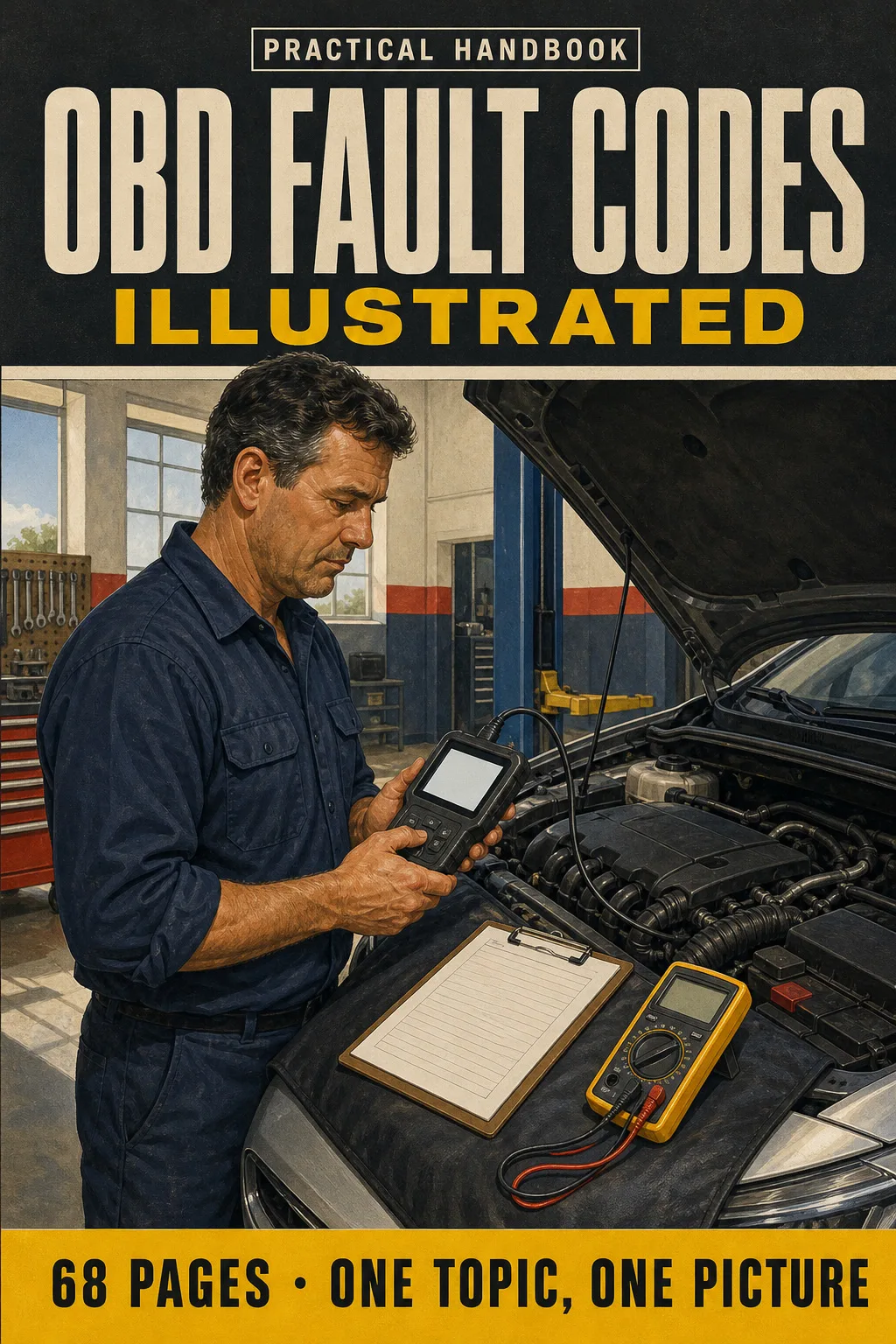
OBD-II and EOBD Fault Codes, Illustrated The Test Before the Part

Fuel trims, freeze frame, misfires, MAF and MAP, O2 sensors, catalyst, EVAP, DPF and the 7-step method, for the petrol and diesel cars on Australian roads. Generic codes, metric units. Every topic has its own page: the drawing first, then what to measure. 68 illustrated pages.

GET THE BOOK + 2 BONUS BOOKS

🔒 Secure checkout · PDF by email · 30-day guarantee

Every topic, its own pageEach code drawn, good signal next to bad, with the explanation beside it
68 illustrated pages8 parts, from how OBD talks to you to the 7 steps on one card
Up-to-date sourcesSAE J2012, ISO 15031-6 and ADR 79
PDF by emailFormat

Look Inside the Book

Every page has one big drawing and a box with the numbers, the test order and the values you need to know:

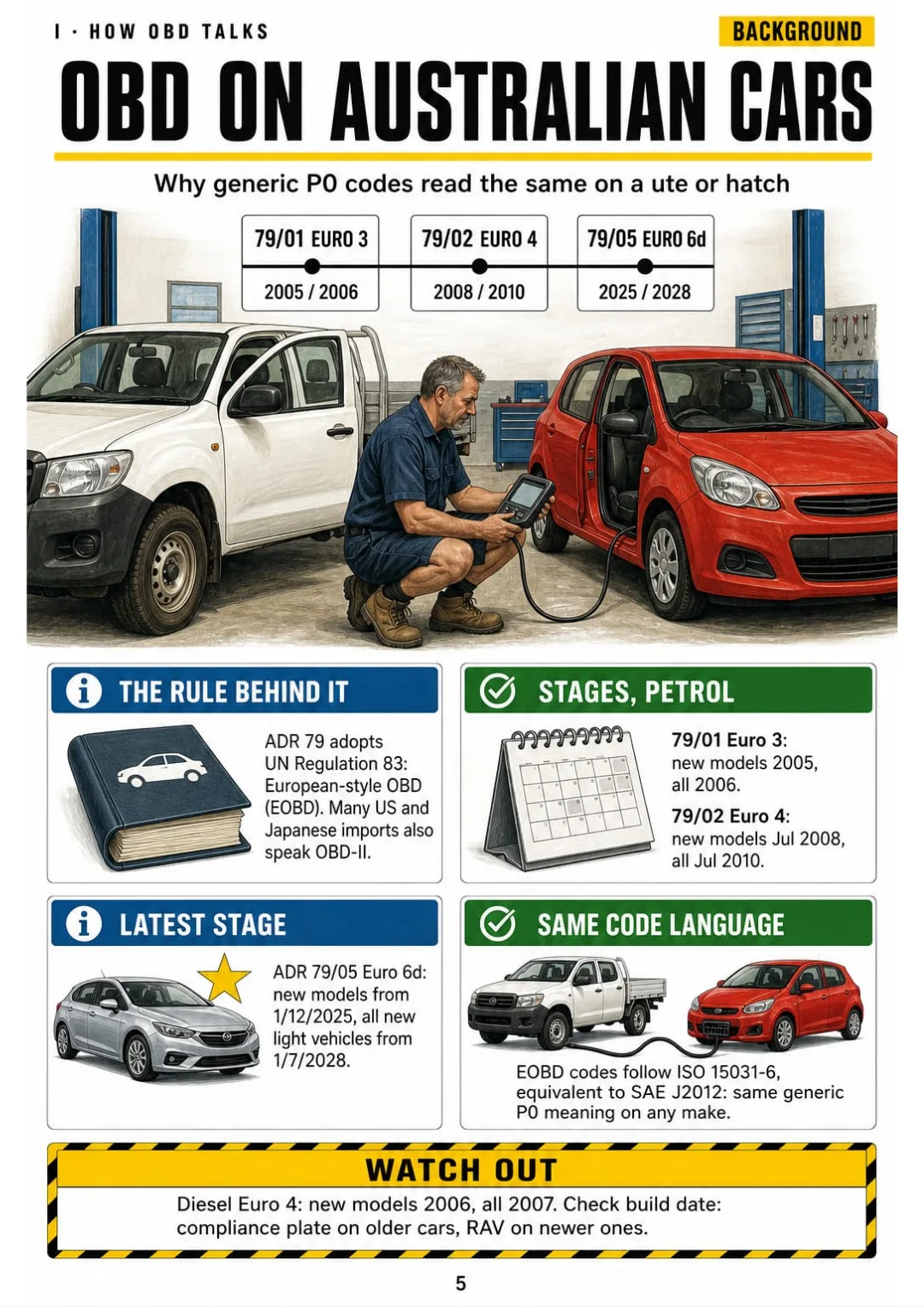
ADR 79 brings EOBD in: generic P0 codes read the same on any make.
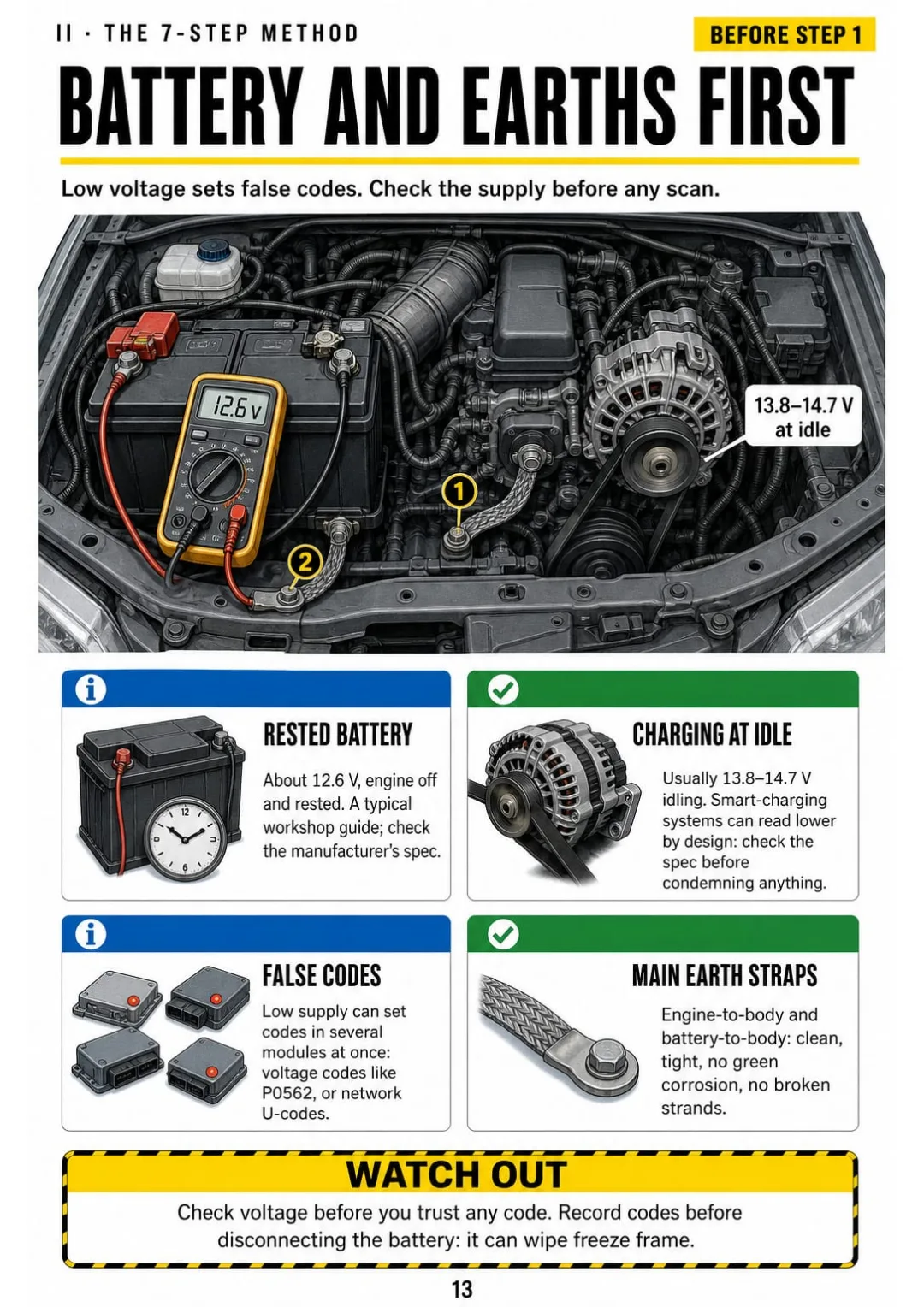
12.6 V rested, 13.8–14.7 V charging at idle, then the two main earth straps
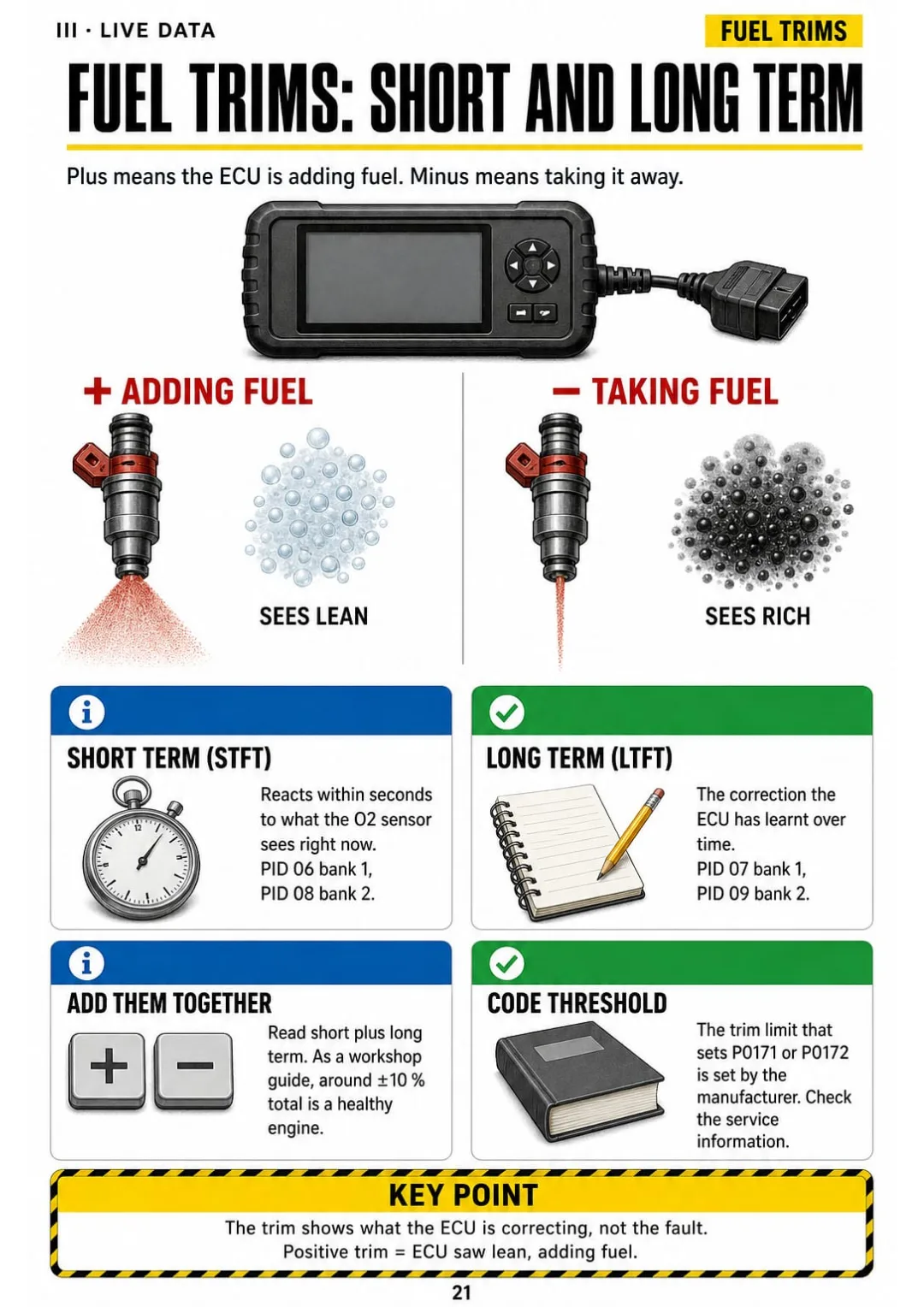
STFT reacts in seconds, LTFT learns: add them, ±10 % is a workshop guide.
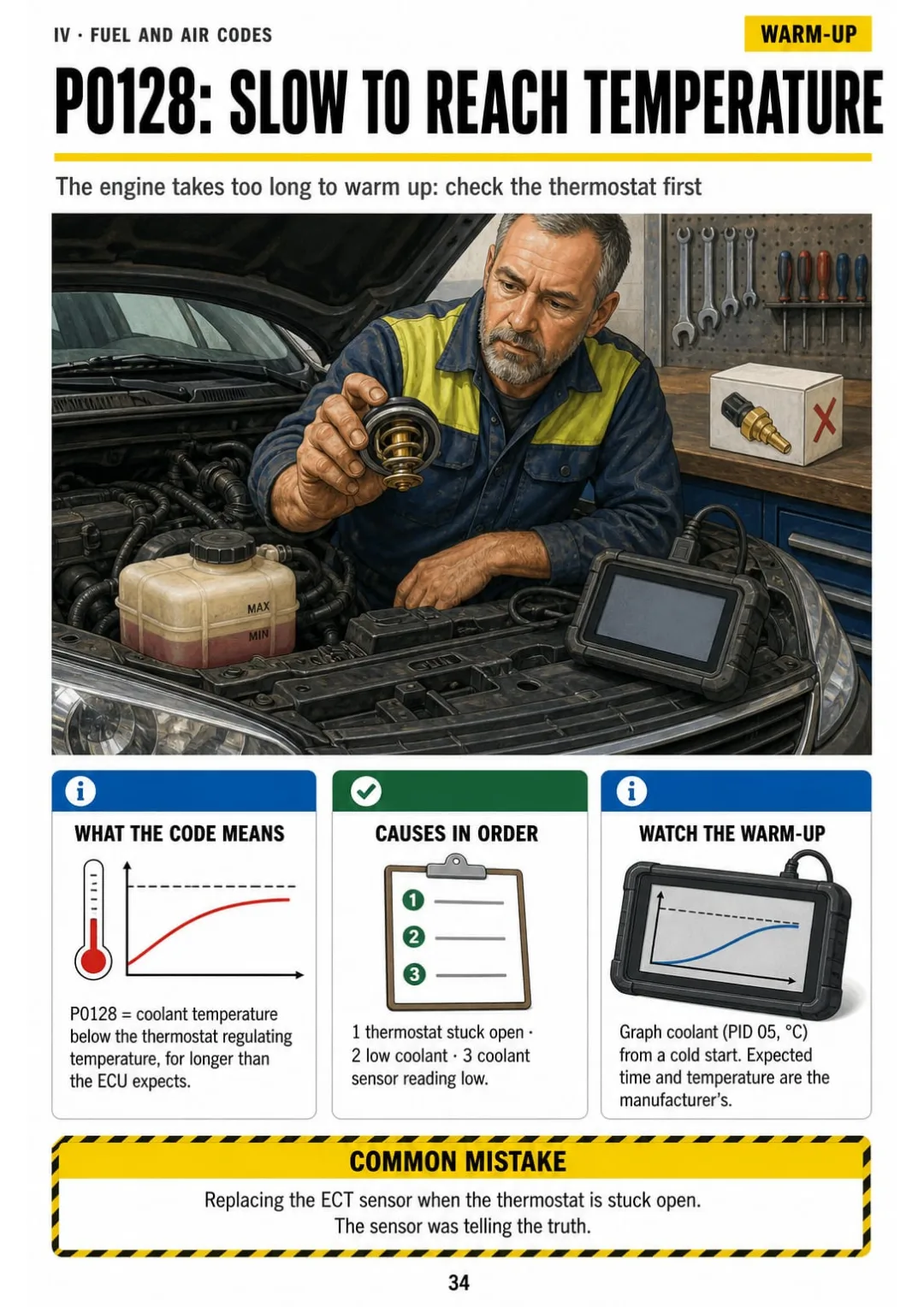
P0128: thermostat stuck open first, low coolant second, sensor last.
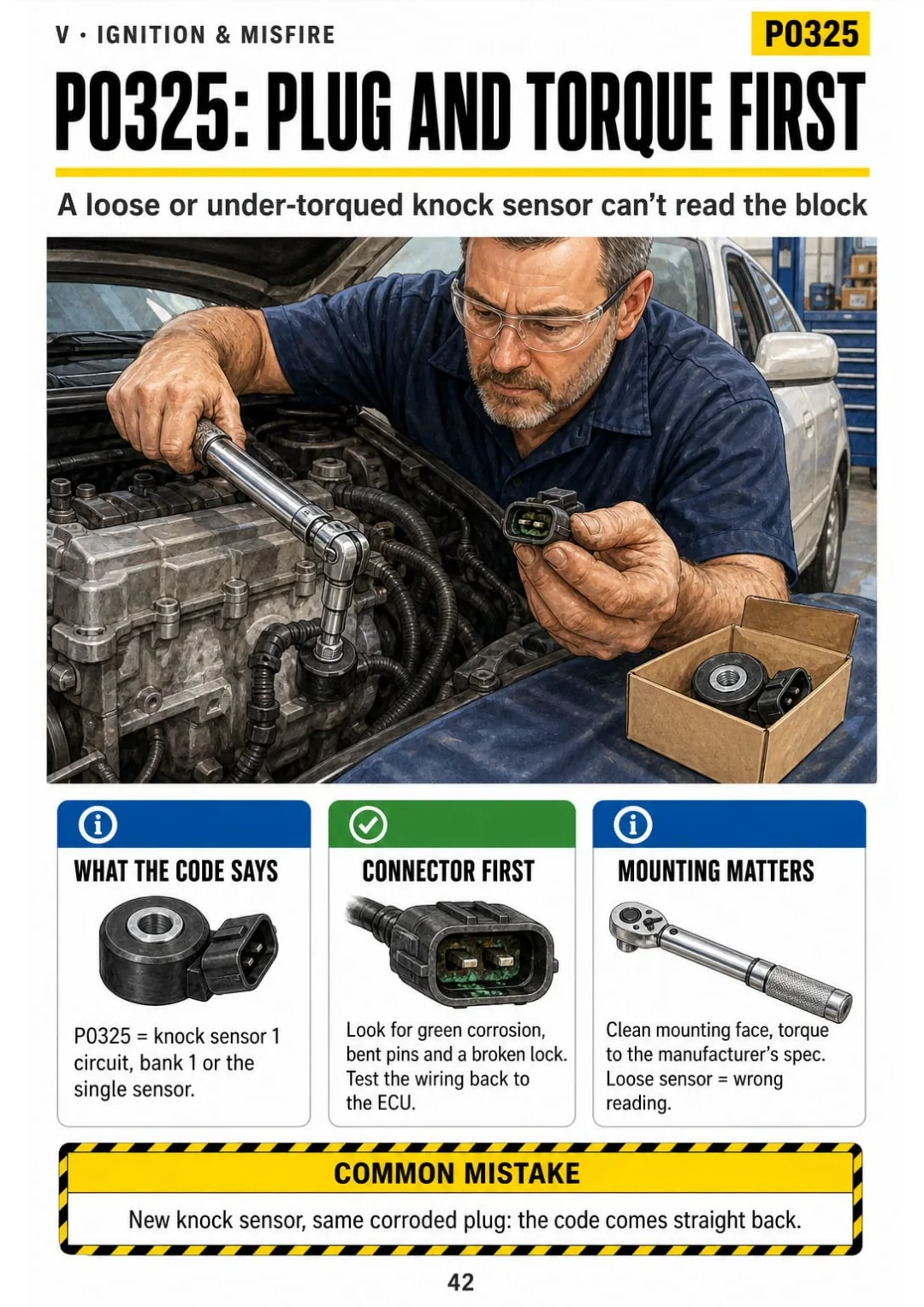
P0325: check the connector and mounting torque before replacing the knock sensor
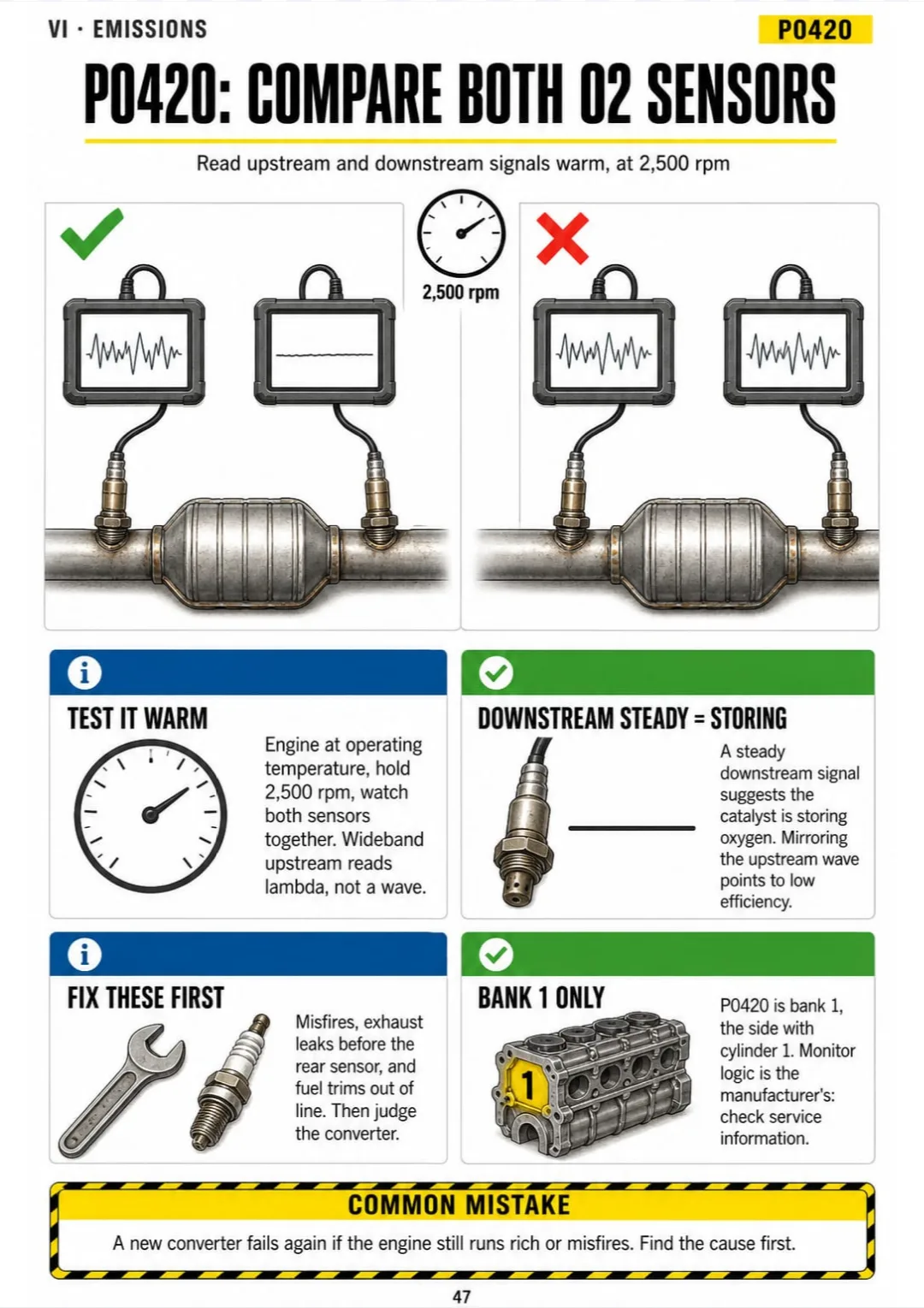
P0420: upstream busy, downstream steady = catalyst storing oxygen; fix misfires and trims first.
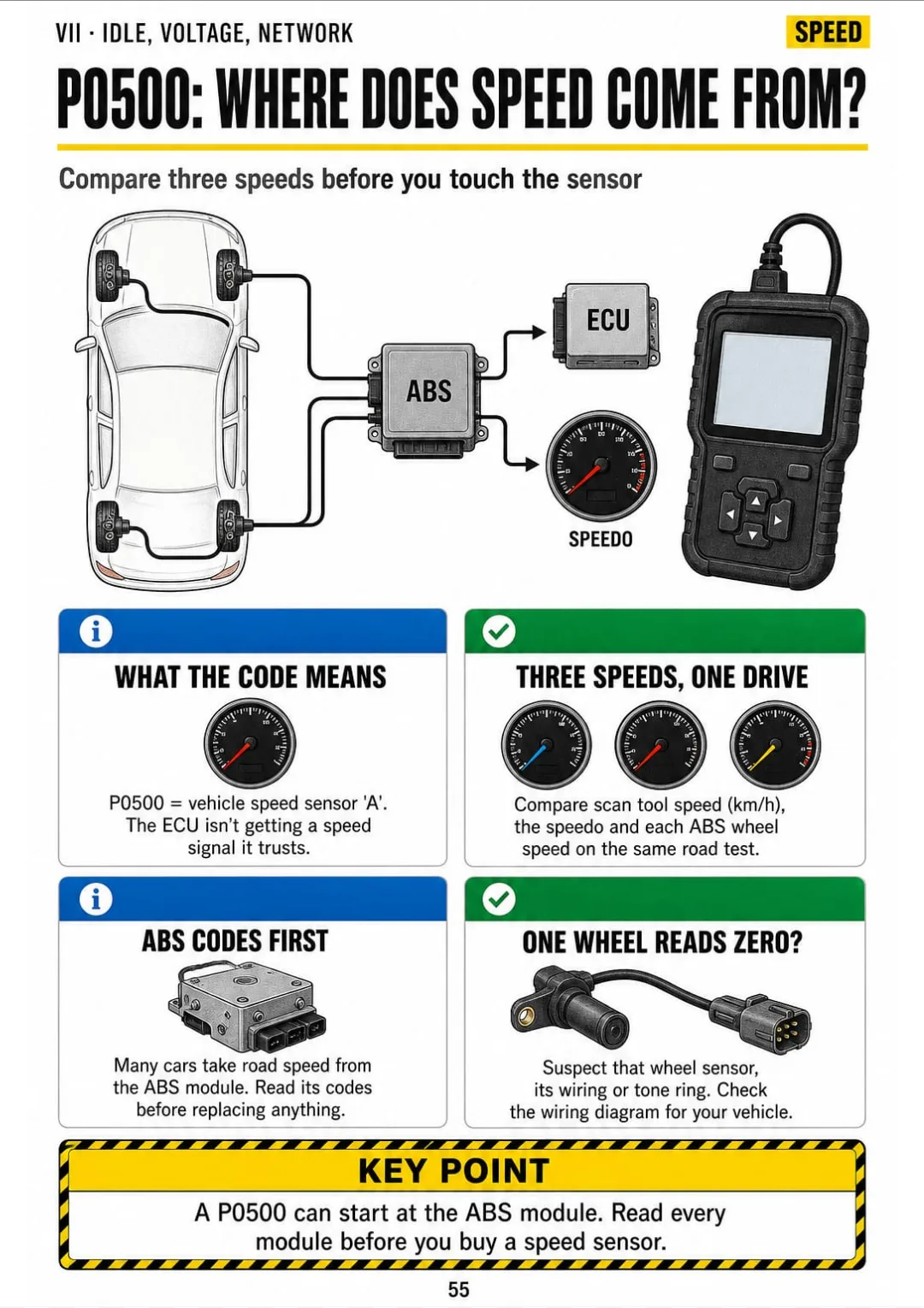
P0500: compare scan tool, speedo and ABS wheel speeds, and read ABS codes first.
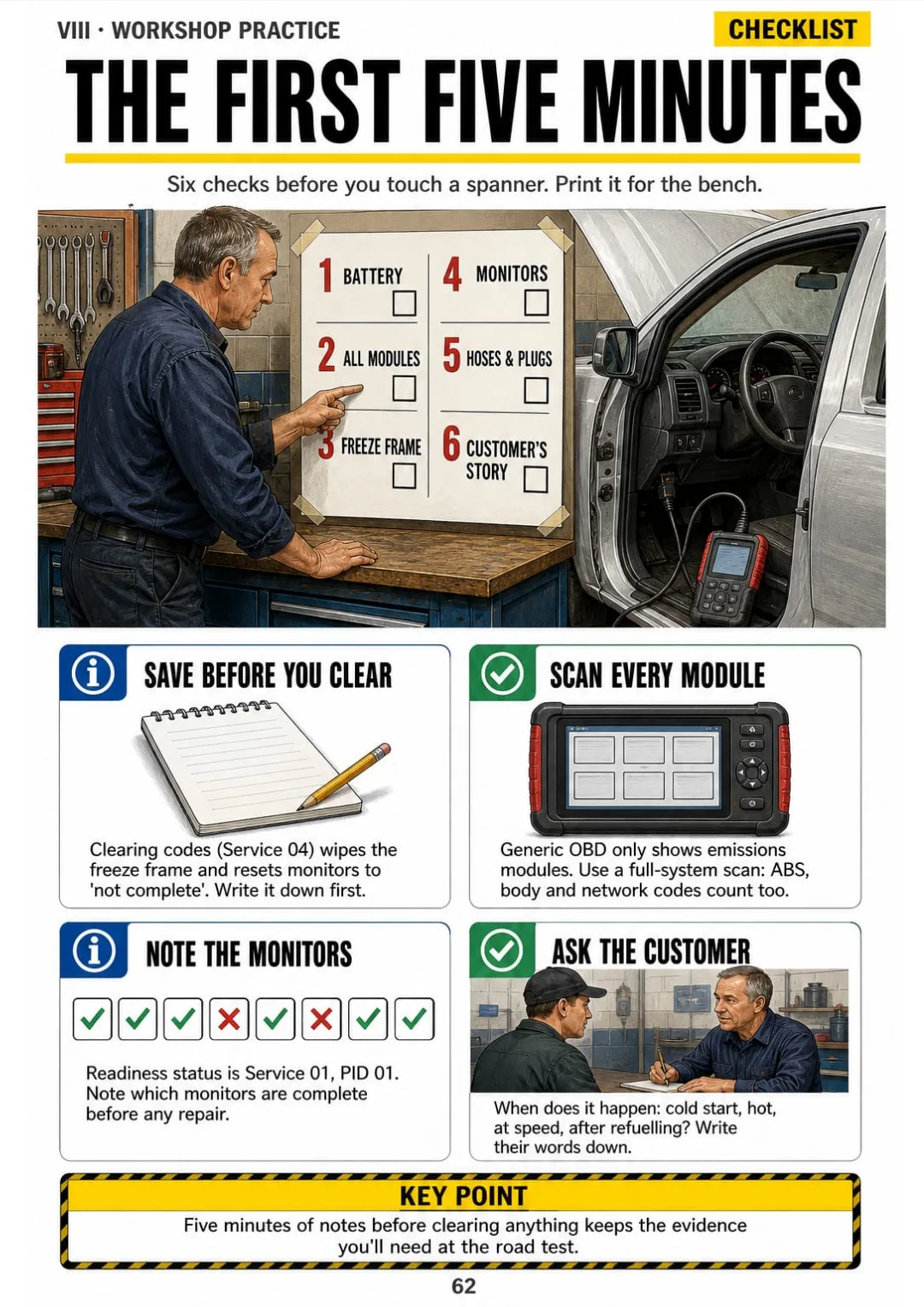
Battery, all modules, freeze frame, monitors, hoses, customer's story: the bench checklist.

Swipe to see more →

These are real pages from the book. The table of contents is the full one: 8 parts and 64 topics.

The Problem Isn't You. It's How It Was Explained.

There's a car on the hoist with a lean code. The scan tool shows short term at +4 % and long term at +18 %. You've got two numbers in front of you and you're not sure which one matters.

The manual gives you a page and a half on adaptive fuel control, closed loop and learned values. It explains fuel trims in paragraphs, and none of them tells you what to do next.

STFT reacts in seconds, LTFT learns: add them, ±10 % is a workshop guide.

In this book, fuel trims get one page. A drawing shows short term reacting in seconds and long term learning slowly, and the box says it plainly: add them together, and ±10 % is a workshop guide.

It's the same for the lean test at idle and 2,500 rpm, the upstream O2 switching signal, MAF grams per second at idle, MAP in kPa and the freeze frame. Each one has its own page.

You read the trims, you know where to look next, and you do the test without going back to the manual.

COMPARE FOR YOURSELF

The Same Topic, Two Ways to Learn It

THIS
  • The manual: line after line of text
  • Battery and earth tests explained only in words
  • You start the job still unsure
When a mass air flow sensor performance fault is recorded, consideration should be given to a number of potential contributing factors prior to component replacement. These may include unmetered air entering the intake tract downstream of the sensor, contamination of the sensing element, restrictions within the air filter assembly, or deterioration of the sensor itself. Reference should be made to live data parameters, including airflow expressed in grams per second at idle, in conjunction with short and long term fuel trim values, in order to establish the most probable cause.
FOR THIS
  • The battery and earth checks in one drawing
  • The voltages in a box
  • You see it and you get it
12.6 V rested, 13.8–14.7 V charging at idle, then the two main earth straps
CONTENTS

Take a Look at the 8 Parts and 64 Topics

How OBD talks to you, the 7-step method, live data, fuel and air codes, ignition and misfire, emissions and DPF, idle, voltage and network, and workshop practice: 68 pages, all illustrated

IHow OBD Talks to You · pp. 5-12
  1. OBD-II and EOBD on Australian cars
  2. The 16-pin port, pin by pin
  3. Reading a code letter by letter
  4. The third digit tells you where to look
  5. Circuit, range or performance: three different faults
  6. Pending, confirmed and permanent codes
  7. Steady light or flashing light
  8. Readiness monitors at a glance
IIThe 7-Step Method · pp. 13-20
  1. Before step 1: battery and earths
  2. Step 1 – Read every module, write it all down
  3. Step 2 – Freeze frame: the photo of the fault
  4. Step 3 – Test the circuit, not the part
  5. Step 4 – Confirm the cause
  6. Step 5 – Repair the cause, not the symptom
  7. Step 6 – Clear codes and reset adaptations
  8. Step 7 – Road test to the freeze frame conditions
IIILive Data You Must Read · pp. 21-28
  1. Fuel trims: short term and long term
  2. The lean test: idle versus 2,500 rpm
  3. Upstream O2 sensor: the switching signal
  4. Wideband (air-fuel) sensors read differently
  5. Downstream O2 sensor: steady is good
  6. MAF: grams per second at idle
  7. MAP: kPa with the key on and at idle
  8. Coolant, intake air and throttle values
IVFuel and Air Codes · pp. 29-38
  1. P0101 – MAF range/performance
  2. P0102 / P0103 – MAF circuit low or high
  3. P0106 – MAP range/performance
  4. P0113 and P0118 – IAT or ECT reading 'cold'
  5. P0117 – ECT reading 'hot' when it isn't
  6. P0128 – Coolant below thermostat temperature
  7. P0171 / P0174 – System too lean
  8. P0172 / P0175 – System too rich
  9. P0121 – Throttle position range/performance
  10. P0087 – Fuel rail pressure too low
VIgnition, Misfire and Timing · pp. 39-46
  1. P0300 – Random or multiple misfire
  2. P0301–P0308 – The swap test
  3. When the misfire stays in the cylinder
  4. P0325 – Knock sensor circuit
  5. P0335 – Crankshaft position sensor
  6. P0340 – Camshaft position sensor
  7. P0016 – Crank/cam correlation
  8. P0011 – Intake cam timing over-advanced
VIEmissions, EVAP, Turbo and DPF · pp. 47-54
  1. P0420 – Catalyst efficiency below threshold
  2. P0401 – EGR flow insufficient
  3. P0455 – EVAP large leak
  4. P0442 and P0456 – Small and very small leaks
  5. P0496 – EVAP purge flow too high
  6. P0299 – Turbo underboost
  7. P2463 – DPF soot accumulation
  8. P2002 and the DPF pressure sensor
VIIIdle, Voltage, Modules and Network · pp. 55-61
  1. P0500 – Vehicle speed sensor
  2. P0505, P0506, P0507 – Idle control
  3. P0562 / P0563 – System voltage low or high
  4. The voltage drop test on earths
  5. P0606 – Control module processor
  6. U0100 – Lost communication with the ECM
  7. P0700 – Transmission control has a code
VIIIWorkshop Practice and Review · pp. 62-68
  1. The first five minutes on any job
  2. Parts swapped for nothing: the top list
  3. When to go to factory information
  4. Explaining 'test before replace' to the customer
  5. Safety at the bench
  6. Quick reference: the numbers on one page
  7. The 7 steps on one card

One Page, One Topic, All Clear

Think of it this way:

A ute comes in with the light flashing and a random misfire code. The owner wants to know if it's the coils, and you need a test order, not a guess.

You open the misfire page and it's all drawn: what the cylinders have in common, with fuel trims, fuel pressure and vacuum checked before a single coil comes out.

P0325: check the connector and mounting torque before replacing the knock sensor

Same with the MAF code, the catalyst code, the speed sensor, fuel trims and the battery and earth checks: each one sits on its own page.

OBD Fault Codes Illustrated is 8 parts and 64 topics, all drawn, with the key numbers on one page and the 7 steps on one card at the end.

What you see drawn, you don't have to memorize.

What's Inside OBD Fault Codes Illustrated:

Ipp. 5-12

How OBD Talks to You

OBD-II and EOBD on Australian cars, the 16-pin port, reading a code letter by letter, circuit vs range faults, pending and permanent codes, the flashing light and readiness monitors.

IIpp. 13-20

The 7-Step Method

Battery and earths first, then read every module, freeze frame, test the circuit, confirm, repair the cause, clear and reset, and road test to the freeze frame conditions.

IIIpp. 21-28

Live Data You Must Read

Short and long term fuel trims, the lean test at idle and 2,500 rpm, upstream, wideband and downstream O2 sensors, MAF in g/s, MAP in kPa, and coolant, intake air and throttle values.

IVpp. 29-38

Fuel and Air Codes

MAF and MAP codes, IAT and ECT readings that don't add up, the thermostat code, lean and rich codes, throttle position and low fuel rail pressure.

Vpp. 39-46

Ignition, Misfire and Timing

Random and single-cylinder misfires, the swap test, when the misfire stays put, knock, crank and cam sensors, crank/cam correlation and cam timing.

VIpp. 47-54

Emissions, EVAP, Turbo and DPF

Catalyst efficiency, EGR flow, large, small and very small EVAP leaks, purge flow, turbo underboost, DPF soot and the DPF pressure sensor.

VIIpp. 55-61

Idle, Voltage, Modules and Network

Vehicle speed sensor, idle control, system voltage low or high, the voltage drop test on earths, module faults, lost communication and transmission codes.

VIIIpp. 62-68

Workshop Practice and Review

The first five minutes on any job, the parts swapped for nothing, when to go to factory information, explaining 'test before replace' to the customer, bench safety and quick reference cards.

At the end of the book: The key numbers on one page, the 7 steps on one card and the list of parts swapped for nothing.
Plus: 2 Free Books

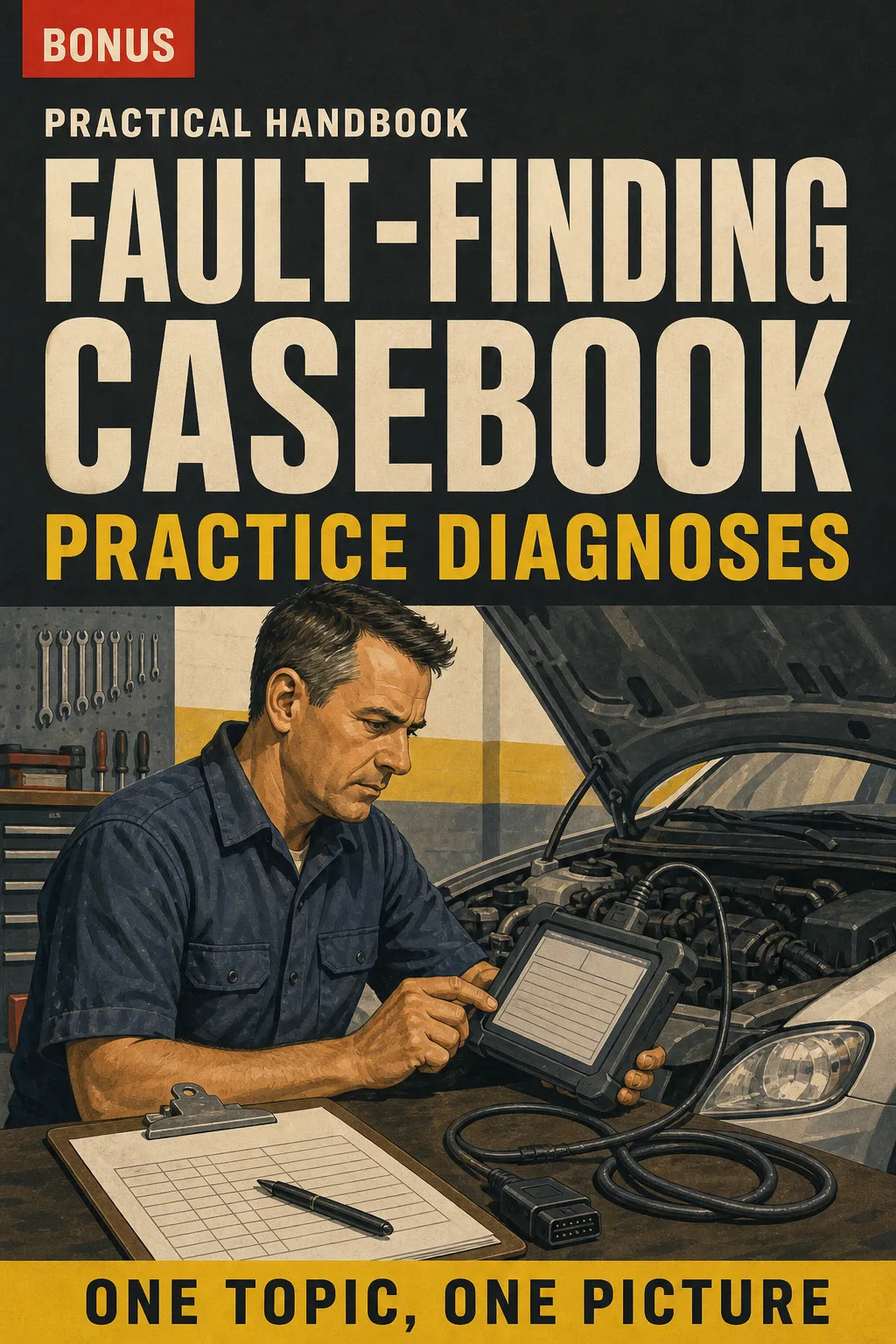
Fault-Finding Casebook: Practice Diagnoses

BONUS 1: «Fault-Finding Casebook: Practice Diagnoses»

Value on its own: US$ 17.90

Work through real-style cases on paper: the code, the freeze frame and the live data, and you decide what to test next before you see the answer.

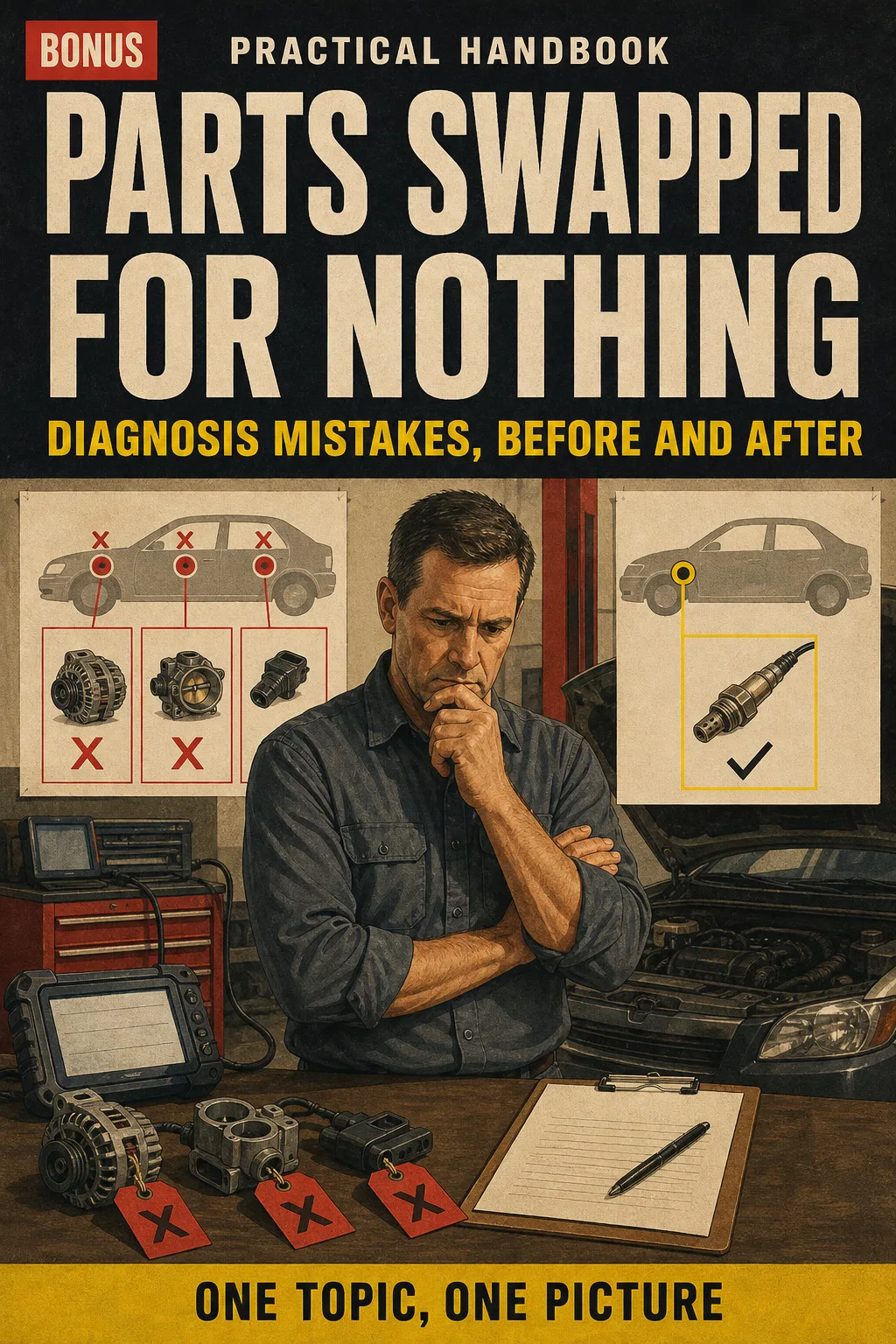
Parts Swapped for Nothing: Diagnosis Mistakes, Before and After

BONUS 2: «Parts Swapped for Nothing: Diagnosis Mistakes, Before and After»

Value on its own: US$ 14.90

The most frequent diagnosis mistakes side by side with the right move, so you stop fitting a part the code never asked for.

OBD Fault Codes Illustrated with 2 Free Books

  • OBD Fault Codes Illustrated: 68 illustrated pagesUS$ 63
  • BONUS 1: Fault-Finding Casebook: Practice DiagnosesUS$ 17.90
  • BONUS 2: Parts Swapped for Nothing: Diagnosis Mistakes, Before and AfterUS$ 14.90
  • High-resolution PDF to printIncluded
Total value US$ 95.80
YOUR PRICE:
US$ 27
You save US$ 68.80
YES, I WANT OBD FAULT CODES ILLUSTRATED FOR US$ 27

📄 This is a digital PDF book sent to your email: nothing is printed or shipped.

Secure purchaseEncrypted payment30-day guarantee

PDF by email: We email you OBD Fault Codes Illustrated as a PDF, together with the two free books. It's a single payment: no installments, no extra charges.

Who This Book Is For

You're moving into diagnosis

You're moving into diagnosis

You learnt on carbies and distributors and now the work comes through a screen. Every code page gives you the same order, so the scan tool starts making sense.

There's a car on the hoist now

There's a car on the hoist now

Open the page for the code, check what to measure and the expected range, and test before you order a part.

You run the workshop

You run the workshop

Keep it printed on the bench for the team, and use the pages to show the customer why testing comes before the quote.

Everything You Get Today

US$ 95.80US$ 27
YES, I WANT OBD FAULT CODES ILLUSTRATED FOR US$ 27

📄 This is a digital PDF book sent to your email: nothing is printed or shipped.

30DAYS
GUARANTEE

30-Day Guarantee

Try OBD Fault Codes Illustrated for 30 days, bonus books included.

We refund everything if the file won't open, if the book isn't what you see here, if you were charged twice or if the email doesn't arrive. Just email us.

You pay once. No subscriptions.

Frequently Asked Questions

Is it for me if I already work on cars and own a scan tool?

Yes. It's written for people who already have the scan tool and the multimeter in hand and want a fixed order from the code to the test to the part. It uses generic OBD-II / EOBD codes and metric units, and doesn't depend on any car or scanner brand. Petrol and diesel are both covered, including EGR, turbo and DPF codes. For manufacturer-specific codes, the 7 steps still apply and the book tells you when to go to factory information.

Where does the content come from?

From the generic code definitions in SAE J2012 / ISO 15031-6 (OBD-II / EOBD), the standards behind the on-board diagnostics required on Australian vehicles under ADR 79. Definitions are in our own words, and every page reminds you to check the manufacturer's service information for exact specs.

Is it official material?

No. It's an independent illustrated reference. It isn't issued, approved or endorsed by any standards body, government department or vehicle manufacturer.

Does it replace a trade course or factory training?

No. It's study and reference material that sits next to your training and the manufacturer's information. Values shown are workshop guides, not factory specs.

My scan tool already gives me the code definition. What does this add?

The definition tells you what the computer saw, not what failed. Each page gives you the causes in the order you test them, what to measure, the expected range as a workshop guide, and the part people swap for nothing. The Casebook cases are written for this book to practise the 7 steps.

When and how does it reach me?

The book and the 2 bonus books arrive as PDFs by email, to the address you enter at checkout.

Do I have to pay every month?

No. It's a one-off payment. No subscription.

Can I have it on paper?

Yes. It's a PDF you can print at home or at a print shop and keep on the bench.

How does the refund work?

You have 30 days. We refund everything if the file won't open, if the book isn't what you see on this page, if you were charged twice or if the email doesn't arrive: just email us.

Before You Close This Page

No more rereading forum threads that don't stick.

Fuel trims, misfires and earths: you see them drawn, and that's it.

You start every job knowing where everything is.

Drawings make studying faster.

The book is right below.

One-time payment: US$ 27 · Guarantee: 30 days · PDF by email

YES, I WANT OBD FAULT CODES ILLUSTRATED FOR US$ 27

📄 This is a digital PDF book sent to your email: nothing is printed or shipped.